How Entrepreneurs Use AI to Challenge Debt Collectors
It hits you like a virtual sledgehammer. You receive an email with a heading that stops you cold: "URGENT: Legal Payment Required" or "NOTICE: Stop All Activities." Your mind abruptly switches from business planning and growth strategies to one terrifying number. A demand for $50,000, $100,000, or even more for an alleged copyright violation or an old, forgotten debt. Your initial response is to call a lawyer, but this instinct is followed by a second wave of anxiety when you discover the retainer fee: $10,000, $15,000, or up to $25,000 for initial representation. Countless small business operators confront this difficult dilemma-a choice between a settlement that could destroy your business and a budget-breaking legal conflict.
What if there was another way? What if you could fight back intelligently, strategically, and affordably? For an increasing amount of entrepreneurs, this solution is becoming available through AI legal defense. This isn't about replacing lawyers entirely, but about changing the rules of the game. It's about leveraging advanced AI to analyze threats, prepare responses, and understand your rights before paying for traditional legal counsel. This is the story of how small business owners are turning the tables on legal bullies, saving hundreds of thousands of dollars, and finding the confidence to protect their enterprises in an environment of growing legal challenges.
Essential Key Points
- Power Dynamics are Changing: Artificial intelligence is enabling business owners to manage common legal issues themselves, decreasing reliance on expensive legal counsel for preliminary legal responses.
- Understanding is Your Greatest Shield: Most legal threats targeting small businesses are designed to intimidate and typically rest on weak legal foundations. Knowledge of basic copyright law and debt validation procedures serves as your strongest defense.
- AI as a Research Assistant: AI systems can review legal paperwork, identify weaknesses in claims, and find applicable legal precedents in significantly less time than manual research, cutting down on expensive billable hours.
- Pricing is a Critical Element: Considering typical legal retainers that begin at $10,000-$25,000, artificial intelligence-based solutions offer a cost-effective first line of defense at a significantly lower price point.
- Recognizing When to Consult a Professional: Artificial intelligence is a helpful resource for preliminary work and first steps, but it cannot serve as a replacement for a licensed attorney when dealing with legal proceedings or intricate legal issues.
Understanding the Legal Risks and Challenges for Small Businesses
The life of a small business owner involves managing numerous responsibilities. You end up being the executive, marketing specialist, personnel manager, and often the cleaning staff. The last thing you can afford is legal trouble when managing your business. Unfortunately, the modern business world is a legal minefield. Research from 2023 reveals that U.S. small businesses face costs of $160 billion per year from legal disputes. We're not talking about just big-ticket litigation; it's the regular legal issues that gradually drain businesses.
The Emergence of the Litigation Bully
Numerous legal threats have little to do with justice; they are essentially a numbers game. Aggressive collectors, predatory firms, and copyright trolls dispatch massive amounts of threatening correspondence, knowing that some of people who receive them will be too scared or too uninformed to stand up for their rights. They count on the fact that the cost of hiring a lawyer typically exceed than the settlement they are demanding. This creates a problematic motivation to settle, irrespective of whether the demand is legitimate. These organizations act as legal bullies, employing intimidation as their main tactic.
Major Challenges for Business Owners
While legal complications can arise from multiple angles, a few common issues regularly plague small businesses:
- Copyright Infringement Claims: These issues are frequently related to pictures displayed on company websites or blogs. The majority of these claims are processed by automated systems and distributed without any human review of the context or fair use principles.
- Debt Collection Notices: You might receive notices about expired, challenged, or unverified debts. Collection agencies typically purchase debt for pennies on the dollar and then use aggressive tactics to collect the full amount.
- Cease and Desist Letters: Such formal notices can address a wide range of legal issues, including intellectual property conflicts and contractual breaches. They are frequently employed to pressure competitors or discourage critics.
- Banking and Payment Disputes: Conflicts with payment processors or banks can suspend financial access and operations, putting business operators in a defensive position.
For entrepreneurs facing these threats, each situation feels like a full-blown crisis. What's important to understand is that a majority of these situations are fundamentally matters of education and preparedness, rather than legal issues.
Understanding Legal Defense Costs: Traditional Methods Falling Short for Small Businesses
The traditional approach for handling a legal challenge is clear-cut: you engage legal counsel. For large corporations with internal legal departments and deep pockets, this is a standard expense of doing business. For a small company, it's a significant financial strain. The average legal spend for a small company is around $13,300 each year, but this amount can skyrocket when litigation is involved, with costs ranging from $3,000 to over $150,000.
The Truth About Retainers
The most significant immediate obstacle is the attorney retainer. A retainer is basically an initial deposit for legal services, and in legal disputes, it's seldom less than five figures. This creates what is often called the "retainer trap." A business owner might receive a claim for $8,000. Legal counsel requires a $15,000 retainer to fight it. Financially speaking, the practical option becomes settling for the $8,000 settlement, even if the allegations are unfounded. This is the approach that predatory litigants depend on. They've strategically set their claims to be just below the cost of entry for legal representation.
Conflicting Motivations
Additionally, the conventional legal approach is based on billable hours. When a case takes more time, the lawyer earns more money. Though conscientious lawyers work efficiently, the system itself tends to reward complexity and drawn-out disputes. This presents a clear contradiction with what matters to business proprietors, who require solutions that are quick, efficient, and cost-effective. The key priority for the business owner is to address the situation, not to get caught up in a time-consuming and expensive legal battle.
How AI is Revolutionizing Legal Support for Business Owners
For decades, expensive legal representation produced an enormous disparity in the market. No practical solution existed for business owners who were unable to finance a lawyer but didn't want to surrender to baseless claims. Artificial intelligence is presently closing that gap. It's not a magic wand, but it functions as an effective instrument that creates equal opportunities by significantly decreasing the expenses and duration involved in the crucial first phases of a legal defense.
AI: Transforming Paralegal Work
Imagine AI as a paralegal equipped with the capability and photographic memory to process enormous volumes of documents per minute. Here's how it's being applied:
- Document Analysis: AI-powered solutions can thoroughly review formal legal correspondence and instantly identify critical details, like formal charges, relevant legal codes, and financial demands. It can compare the document with numerous comparable precedents to discover common issues and deficiencies.
- Legal Research: Instead of an attorney dedicating hours (at $300+ per hour) examining legal cases, artificial intelligence can search legal databases and provide relevant precedents within moments. The AI can identify data on consumer protection laws, fair use guidelines, or debt validation requirements that apply to the matter.
- Drafting Assistance: AI can assist with creating preliminary response letters. When given the case information and applicable legal standards, it can create a well-crafted, well-structured reply that establishes your position and signals to the other party that you will not be an easy target.
Here's where everything shifts. The first evaluation and examination, which usually amounts to thousands in legal fees, can be completed with a more affordable investment in an AI-powered educational platform.
Understanding the AI Legal Defense Framework: A Systematic Approach
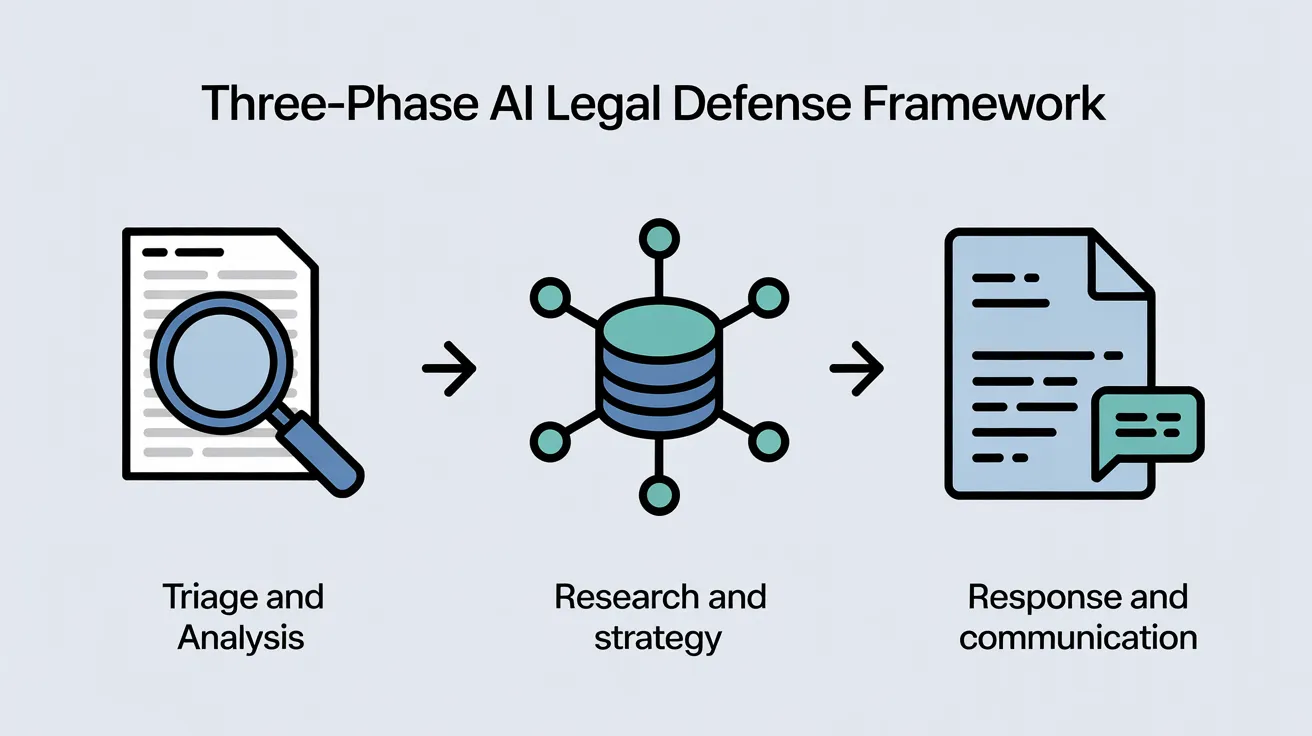
Utilizing AI for legal defense isn't simply mindlessly following a chatbot. It involves implementing a systematic framework to analyze the situation, grasp your stance, and reply from a foundation of strength. This approach usually encompasses three critical phases.
Phase 1: Initial Review and Analysis
The initial phase is to leverage artificial intelligence to understand exactly what you're facing. You can input the legal threat or demand letter into an AI tool and ask it to perform an initial evaluation. The aim is to resolve several critical questions:
- What is the core allegation
- What specific laws or regulations are being referenced?
- Has the party making the claim proven they're the true rights holder?
- What proof have they provided?
- Are there any immediate red flags or warning signs within their submission?
This initial assessment enables you to progress from a worried state to a state of informed awareness. It gives a straightforward, neutral assessment of the current state.
Stage 2: Research and Planning
Once you comprehend the claim, the next process is to leverage AI to examine your defensive options. For a copyright claim, you can prompt the AI to research the four factors of fair use and their relevance to your individual situation. For a debt collection notice, you must direct it to outline the validation requirements under get more info the Fair Debt Collection Practices Act (FDCPA). This step is dedicated to constructing your case. You are compiling the legal principles and facts that will form the framework of your response. This is also where you can initiate to recognize the shortcomings in your counterparty's position.
Stage 3: Response Protocol
After completing your research, you can utilize AI to assist in drafting your reply. This isn't about generating an automated letter. Rather, it focuses on using AI as your writing assistant. You input the main arguments and relevant details, and the AI helps formulate them into a well-structured and polished response. Your letter should normally:
- Confirm the receipt of their correspondence.
- State your viewpoint clearly and concisely.
- Cite the relevant legal foundations that reinforce your stance.
- Request further details and verification, where appropriate.
- Keep the content factual and emotion-free.
This methodical response demonstrates to the opposing party that you are organized, informed, and prepared to support your stance. It immediately changes the situation from one of intimidation to one of a serious legal conversation.
Managing Copyright Claims Through AI Analysis and Response
Copyright infringement issues are a major concern for digital enterprises. Organizations may incorporate a photograph on their blog, and later face a hefty financial demand from a photo licensing agency down the line. AI can be particularly effective for such cases.
Analyzing the Claim
An automated system can assist in examining the legal demand. It examines the claim letter to check whether it provides copyright ownership documentation, a legitimate copyright registration, and a specific account of the supposed copyright breach. A lot of claim letters from copyright trolls are deliberately ambiguous and lack this vital documentation. As entrepreneur Tony copyright of LinkDaddy learned, artificial intelligence can be utilized to assess the merit of a copyright claim, enabling an effective defense against a $500,000 copyright demand without legal representation.
Understanding Fair Use Principles
Artificial intelligence serves as a valuable instrument for investigating the doctrine of fair use. Fair use is a legal concept that enables restricted usage of copyrighted material without authorization from the intellectual property owner. An AI can help you understand the four factors of fair use and how they may impact your case, delivering you with the reasoning you need to build a strong defense.
Debt Collection Defense: AI-Powered Validation Strategies
One more field where AI is having a substantial effect is in standing up to intimidating collection agents. The FDCPA gives business owners and consumers particular legal rights, like the right to request debt documentation.
The Power and Impact of Validation Documentation
A debt collection company needs to provide you with details about the debt, called validation information. When you send a debt validation letter, you are officially asking that the collector verify that you owe the debt and that they have the legitimate claim to collect it. Many collectors, specifically those who purchase old debt, are unable to furnish this documentation. An AI can assist you with creating a comprehensive debt validation letter that asks for all the essential details, such as:
- The name of the initial creditor
- The initial account number
- An authentic copy of the initial signed contract.
- A detailed account of the purported financial obligation.
Submitting a proper validation letter typically halts a debt collector in their tracks. Should they be unable to validate the debt, they cannot legally pursue collection.
When AI Legal Defense Works (And When It Doesn't)
It is vital to recognize the boundaries of AI in the legal sector. AI serves as an educational and preparatory tool, not a legal professional. Identifying the distinction between what you can address personally and when you should seek legal counsel is the key to a solid defense strategy.
Situations Perfect for AI-Powered Defense
- Initial Threat Assessment: Evaluating legal demands and cease and desist documentation.
- Responding to Baseless Claims: Crafting professional replies to debt collection agencies and copyright harassers who depend on threatening behavior.
- Legal Research: Analyzing the legal rights and the legal frameworks that apply to your circumstances.
- Organizing Your Case: Getting your documentation and arguments ready before consulting a lawyer, potentially saving you a substantial amount in attorney costs.
When You Should Hire an Attorney Immediately
There are particular circumstances when you shouldn't attempt handling your own legal defense. When you receive legal papers, you must get an attorney. Other scenarios calling for professional legal help are as follows:
- Criminal indictments.
- Government agency regulatory investigations.
- Complicated legal cases concerning different parties across multiple jurisdictions.
- High-stakes scenarios where the potential damages could destroy your company.
In such cases, the function of AI shifts from a main protective tool to an auxiliary tool. You can employ it to be more educated and prepared as a client, but you require a human expert in your corner.
Building Your AI Legal Defense Toolkit
Getting started with AI legal defense doesn't need a degree in computer science. It mainly needs a willingness to learn and access to the appropriate tools. The foundation of your toolkit will be a capable language model like ChatGPT or Claude, alongside an learning platform that provides specialized prompts and frameworks for standard legal threats.
The Significance of Quality AI Instructions
The effectiveness of any AI platform depends on the quality of the prompts you provide. A generic prompt like "write a response to this demand letter" will produce a basic and potentially inadequate result. On the other hand, a detailed prompt will direct the AI to perform an in-depth evaluation and generate a response based on precise legal guidelines. This explains why platforms that provide field-tested prompts and frameworks are so important.
Small Business Victory Stories: Fighting Back and Winning
The inspiring case of Tony copyright, who protected his business more than $511,000 by utilizing AI to overcome three major legal threats, stands as a powerful illustration of what is possible. Yet he isn't alone. Throughout the country, small business owners are discovering that they have more power than they believed. They are using AI to dispute baseless copyright claims and compel debt collectors to validate their debts. These victories are not just about financial savings; they are about regaining a sense of control and refusing to be victims of a system that has historically been biased against them.
Small Business Legal Protection: A Look Ahead
The adoption of AI in the legal sector is just beginning to emerge, but the pattern is evident. Legal services are becoming more attainable and cost-effective. The established authorities of the legal profession are facing disruption by technology that empowers small businesses and individuals. This doesn't suggest that lawyers will become obsolete. It means that their role will adapt. They will be able to concentrate on the high-level, complex work that genuinely needs their expertise, while technology handles the more basic and preliminary work.
Small business proprietors, this represents an encouraging shift. It means that going forward, a legal challenge may no longer be a source of monetary distress, but rather a challenge to be handled systematically and intelligently.
Making Your First Move: Your First Steps with AI Defense Solutions
For small business owners, it's crucial to understand AI legal defense right now, prior to any issues arising. Get to know existing resources and solutions. Understand the basic principles of legal protection and financial recovery. Through these preventive measures, you can protect your business effectively. You can evolve from being an exposed entity into a well-equipped protector of your business achievements.
Common Questions (FAQ)
Can AI truly assist with legal defense, or is it just marketing hype?
Artificial intelligence serves as a valuable resource for legal defense, but it's important to understand its role. It is not a replacement for a lawyer. Instead, think of it as an exceptionally capable research and preparation assistant. It assists in analyze documents, grasp complicated legal matters, and prepare preliminary responses, all of which results in saving substantial resources. The essential approach is to utilize it for the initial stages of a defense and to recognize when to involve a human expert.
How do I choose between AI tools and legal counsel?
Consider using AI tools when conducting the initial evaluation of potential legal issues, for responding to what appear to be meritless claims (including those from copyright trolls), and to structure your case materials. It's essential to consult a lawyer without delay if you are presented with a lawsuit, encounter criminal charges, or are dealing with a intricate legal situation that could influence your business. A reliable guideline is: use AI for preparation, but rely on a lawyer to handle court proceedings.
What are the realistic savings of AI-powered legal defense?
The financial benefits are considerable. The initial legal review and demand letter response can cost thousands in lawyer fees. By leveraging AI technology, you can complete this work at a substantially reduced cost. Successfully addressing threats during this initial phase can save you tens of thousands. Should you require an attorney later, prior AI assistance can help decrease their billable hours.
What are the key limitations of AI in legal contexts?
There are multiple key limitations to AI. It doesn't have legal status and can't represent anyone in court. It cannot match the nuanced understanding of a practiced legal professional and could miss subtle details in particular legal matters. Additionally, it functions based on its training data, which might not be up-to-date. Above all, AI can only offer information and assistance, not legal advice.
Are there legal implications when employing AI to perform legal document analysis?
It is absolutely legal to utilize AI for document analysis and comprehension. This is merely using technology as a research and preparation tool, much like using a word processor or search engine. The key legal limitation is that you cannot claim to be a legal professional without proper credentials, and artificial intelligence cannot function as your legal representative.
6. How can I distinguish if a legal threat is legitimate or merely intimidation?
This is where AI analysis proves to be extremely valuable. An authentic legal claim will usually be specific, include supporting documentation (such as a copyright registration number), and originate from a legitimate law firm. A bullying strategy, in contrast, is usually unclear, lacks evidence, and frequently includes hostile or inappropriate language meant to pressure you into immediate payment. AI can help you identify these red flags.
What is the Fair Debt Collection Practices Act (FDCPA) and how does it protect me?
The FDCPA serves as federal legislation that limits how third-party debt collectors. The law shields you from unfair, deceptive, or abusive practices. A key protection offered is the ability to request validation of the debt. When debt collectors fail to demonstrate your responsibility for the debt and their authority to pursue collection, they must stop all collection efforts. This provides essential protection for business proprietors who might face old or invalid debts.